
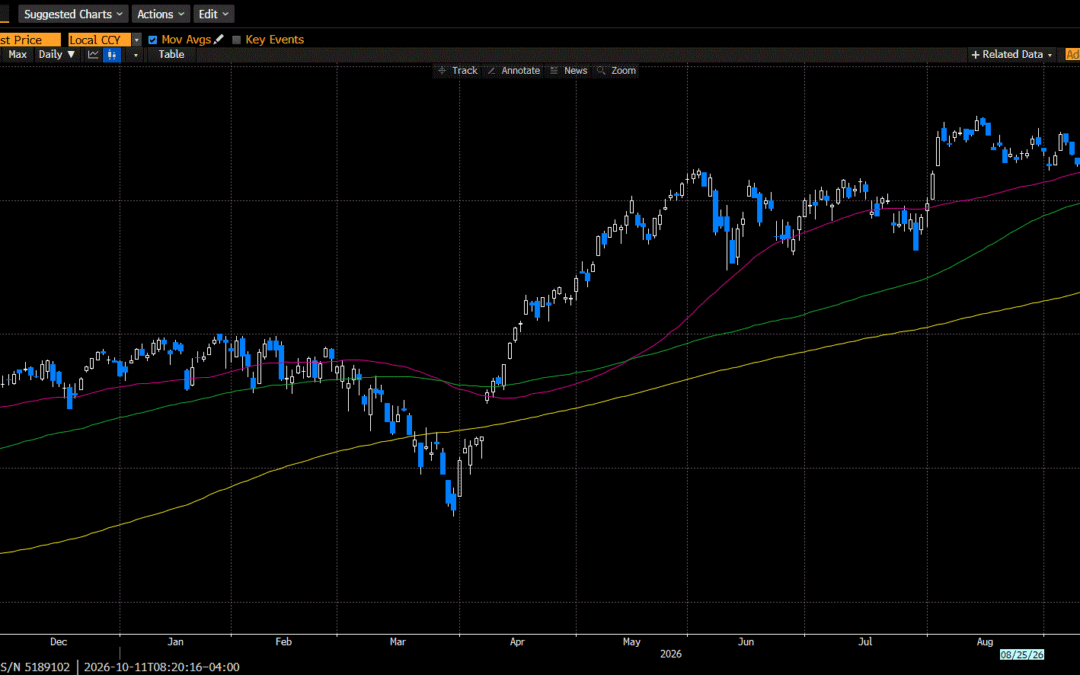
U.S. financial markets logged weekly gains as Wall Street shook off tech sector volatility and focused on stabilizing energy prices. Despite severe global bond market pressure, the S&P 500 rose 1.15% and hit an all-time high this week; the Dow Jones Industrial Average added 0.93%, and the Nasdaq Composite climbed 0.64%, hovering near all-time records. The Russell 2000 fell by 0.9%. Yields across the US yield curve fell after forging new highs for the year. The 2-year note fell three basis points to 4.79%, while the 10-year yield fell four basis points to close at 5.24%. Oil prices increased by just under 1% to close the week at $91.92 a barrel. Gold prices rose 1.3%, or $53.60, to $4216.20 per ounce. Silver prices increased 1% to $61.05 per ounce. Copper rose fourteen cents to $6.69 per Lb. Bitcoin’s price fell 2.35% to $82,800. VIX, a volatility measure, fell 3% to 14.84. The US Dollar index rose by 0.3% to 1021.21.

Tech stocks fell mid-week after a Financial Times report cast doubt on OpenAI’s annualized revenue figures, driving sharp pullbacks in major semiconductor manufacturers like Nvidia, Micron, and Intel. Technology ultimately stabilized by Friday. Crude prices remained highly volatile due to the ongoing war involving Iran and localized tanker attacks in the Strait of Hormuz. However, crude trimmed its steepest gains after President Trump said on social media that the U.S. would not execute strikes before the November 3 midterm elections. Brent crude finished the week around $104.72 per barrel. The global bond sell-off deepened, pushing the benchmark 10-year U.S. Treasury yield to 5.24%. Bond yields spiked aggressively on structural capital demand and long-term federal debt concerns, raising broader
warning flags about rising corporate borrowing costs. Market leadership turned noticeably defensive. Utilities, consumer staples, and healthcare (boosted by Eli Lilly and Moderna) outperformed, while small-cap stocks underperformed as the Russell 2000 closed the week down.

The economic calendar was quiet. ISM Services stayed in expansion at 54.9 but decelerated from the prior reading of 55.4. Initial Jobless Claims fell by 2k to 197k, while Continuing Claims increased by 17k to 1716k. A preliminary look at the University of Michigan’s Consumer Sentiment Index fell to 46.3 from 48.1 on increased concerns about the cost of living.

Investment advisory services offered through Foundations Investment Advisors, LLC (“FIA”), an SEC registered investment adviser. FIA’s Darren Leavitt authors this commentary which may include information and statistical data obtained from and/or prepared by third party sources that FIA deems reliable but in no way does FIA guarantee the accuracy or completeness. All such third party information and statistical data contained herein is subject to change without notice. Nothing herein constitutes legal, tax or investment advice or any recommendation that any security, portfolio of securities, or investment strategy is suitable for any specific person. Personal investment advice can only be rendered after the engagement of FIA for services, execution of required documentation, including receipt of required disclosures. All investments involve risk and past performance is no guarantee of future results. For registration information on FIA, please go to https://adviserinfo.sec.gov/ and search by our firm name or by our CRD #175083. Advisory services are only offered to clients or prospective clients where FIA and its representatives are properly licensed or exempted.